
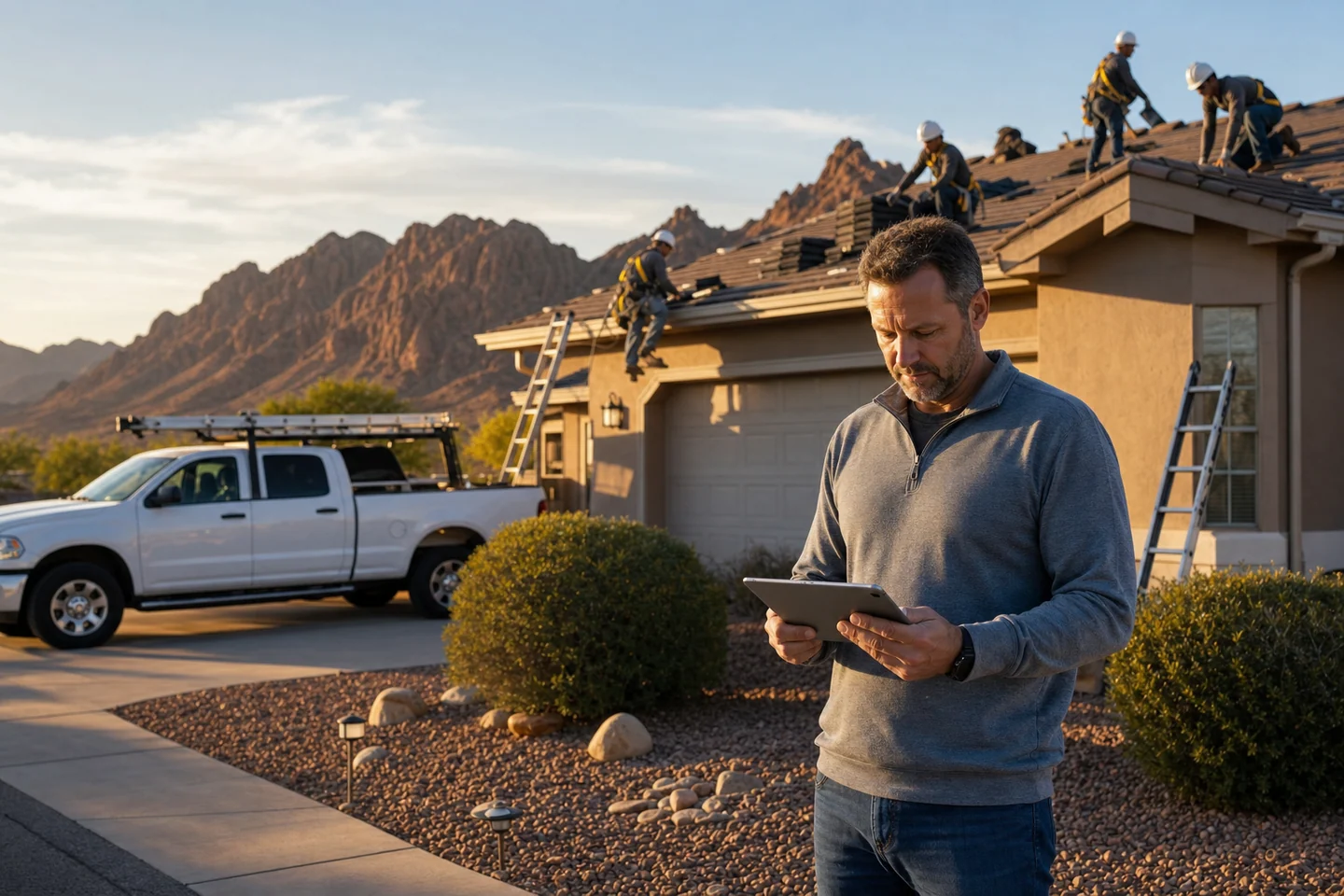
Guide Arizona roofing companies on GL coverage, pricing, and COIs in 2026.
What general liability really covers for Arizona roofing companies
If you own a roofing company in Arizona, you already know that one wrong move can get expensive fast. A dropped bundle can crack tile, a flashing mistake can lead to interior water damage, and a stray nail can end up in a customer’s tire. Between job‑site hazards, monsoon storms, and strict HOA and GC requirements, it is not enough to “have insurance”—you need the right general liability structure for roofing work in this state.
General liability insurance (often shortened to GL) is the policy that responds when your operations or completed work allegedly cause bodily injury or property damage to someone else. For roofers in Phoenix, Queen Creek, and across Arizona, that might mean:
- A homeowner trips over debris in the driveway and gets hurt
- Wind‑driven rain enters through an open roof and damages ceilings and floors
- A roofing nail punctures a neighbor’s tire or damages a nearby vehicle
- A property manager claims your work contributed to a leak months after the job wrapped
Arizona‑wide explainers such as this general liability insurance guide and contractor‑focused overviews like this contractor insurance article make it clear that the state does not legally require GL for every trade. But in the real world, nearly every serious GC, HOA, and commercial client does. They will not let your trucks on site without a certificate of insurance that proves you carry specific limits and endorsements.
For roofing businesses, GL sits at the center of the broader insurance stack that usually includes commercial auto for your trucks, workers compensation for your crews, and an umbrella for larger projects. Search‑volume data around terms like “roofing business insurance” and “general liability insurance” shows that owners are actively looking for clarity on how these pieces fit together—and how much they should expect to pay.
Pricing is driven by several factors you can influence: your annual revenue, payroll, project mix (residential vs. commercial, single‑family vs. multi‑family), subcontractor strategy, and claim history. Underwriters will also look closely at your safety practices and how organized you are with contracts and documentation. A roofing company with written safety meetings, photo documentation, and clean COI files will usually have better options than a company with the same revenue and payroll but poor paperwork.
By the end of this guide, you will understand what roofing GL actually covers, how to pick realistic limits and endorsements for Arizona projects, and what habits will help you keep both coverage and costs under control.
Set GL limits, endorsements, and pricing around real Arizona roofing work
Once you know what general liability is supposed to do for your Arizona roofing business, the next step is to size and structure it around the work you actually perform—from shingle tear‑offs in Queen Creek to tile reroofs in Phoenix and HOA projects across the East Valley. That is where many roofing owners get into trouble. They either grab the cheapest business policy they can find online, or they carry limits and endorsements that were built for a different trade altogether.
A practical way to right‑size your GL is to work backward from your contracts and certificate of insurance (COI) requests. Pull the strictest insurance section you see from your best general contractor, property manager, or HOA. Treat that document as your job spec. If it calls for $1,000,000 per occurrence and $2,000,000 aggregate, additional insured status for ongoing and completed operations, primary and non‑contributory wording, and a waiver of subrogation, your policy should be built to deliver those items on every job—not just that one project.
Roofing‑focused and contractor GL explainers—such as statewide guides to general liability in Arizona and construction‑specific overviews like this contractor insurance requirements guide—confirm that $1M / $2M limits are now a common baseline. Larger commercial, multi‑family, and public projects may push expectations higher, which is where a commercial umbrella becomes the most efficient way to stack extra protection on top of your GL and auto without rebuilding everything from scratch.
Endorsements and exclusions matter just as much as headline limits. On the endorsement side, most serious Arizona roofers will want:
- Additional insured coverage for both ongoing and completed operations (often via blanket CG 20 10 and CG 20 37‑type endorsements)
- Primary and non‑contributory wording where contracts require your policy to respond first
- Waivers of subrogation for key GCs, property managers, and owners
On the exclusion side, you must read carefully for any language that quietly cuts out the work you actually do. Cheap, generic GL policies often contain:
- Broad residential or “tract home” exclusions that gut coverage on subdivisions and production work
- Condominium, townhome, or multi‑family exclusions that conflict with HOA reroofs
- Roofing‑specific exclusions that limit coverage for hot work, open roofs, or subcontracted roofing operations
- Height or pitch restrictions that do not match the roofs your crews climb every day
Whenever you see an exclusion that targets a project type you regularly take on—two‑story tile, condo reroofs, or flat commercial roofs—that is a red flag. The question is not whether you can “get by” with that policy, but whether you are comfortable betting your company on the hope that no claim will ever hit those excluded jobs.
Finally, make sure your GL is aligned with your subcontractor strategy. If you hire subs for tear‑offs, foam, coatings, or gutters, your policy should be written with that reality in mind. Most carriers expect you to:
- Use written subcontractor agreements that require equal or better GL limits
- Collect and verify certificates of insurance (GL and, ideally, workers comp) before subs get on a roof
- Keep those COIs on file for at least the length of your state’s construction defect statute
When your GL limits, endorsements, exclusions, and subcontractor practices all line up with your actual Arizona roofing work, you are no longer “hoping” your policy will respond—you have built it to do exactly that.
FAQ: Arizona roofing general liability, COIs, and exclusions
Even a well‑built general liability policy will drift out of alignment if you treat it as a set‑and‑forget purchase. Roofing businesses change quickly: you might add a repair division, expand from residential into HOA or light commercial work, or start using more subcontractors during busy seasons. To keep your GL working for you instead of against you, build simple habits around documentation, reviews, and claims.
Start with documentation that makes COIs almost automatic. Keep a digital folder that includes:
- Current copies of your GL, commercial auto, workers compensation, and umbrella policies
- Your Arizona ROC license, bonds, and master subcontractor agreements
- A list of your top GCs, HOAs, and property managers, with the exact insurance language their contracts require
When a new job comes up, you (or your advisor) can quickly compare the contract to your current coverage. If everything matches, issuing a COI with the right limits, additional insured status, primary and non‑contributory wording, and waiver of subrogation becomes a same‑day task instead of a multi‑day scramble.
Next, schedule two check‑ins on your calendar every year. At mid‑term, compare your actual revenue and job mix to what you projected on your application. If you are growing faster than expected or taking on higher‑risk work (multi‑family, steep tile, large commercial), adjust the policy before audit. Before renewal, hold a deeper strategy meeting: bring loss runs, your strictest contract requirements, and a list of upcoming projects for the next 12–18 months. Use that conversation to confirm limits, shop for roofing‑friendly carriers if needed, and make sure no new exclusions have slipped into the quote.
Finally, treat every significant claim or near‑miss as a chance to tighten your whole insurance stack. After an incident—a blown‑off section of roof, water intrusion, or a job‑site injury—ask two sets of questions. First: what did our GL do? Did it respond the way we expected, or were there surprises around deductibles, exclusions, or defense costs? Second: what operational changes would make the same type of claim less likely or less severe? That might mean better documentation on change orders, tighter quality‑control photos, stronger fall‑protection practices, or clearer scopes of work for subs.
Over time, those small improvements add up. Stronger safety and documentation reduce claim frequency and severity, which improves your loss history and makes you more attractive to quality carriers. Better carrier options, in turn, can lead to more stable pricing and broader coverage for your Arizona roofing company.
FAQ: Arizona Roofing General Liability, COIs, and Exclusions
Q: What GL limits do most Arizona roofing contractors carry?
A: Many small and mid‑sized roofers carry at least $1,000,000 per occurrence and $2,000,000 aggregate, often paired with an umbrella for larger commercial, multi‑family, or public projects. Your strictest contract should set the floor, not the ceiling.
Q: Does my GL policy cover leaks and workmanship issues?
A: GL is designed for accidental property damage and bodily injury, not pure “do‑over” work. Some policies include limited coverage when faulty work causes resulting damage (like interior water damage), but they will not pay to fix every punch‑list item. Wording varies by carrier, so it is critical to review this carefully.
Q: What GL exclusions should Arizona roofers watch most closely?
A: Pay attention to exclusions for residential work, condos and townhomes, multi‑family projects, roofing operations, subcontracted work, and height or pitch limits. If an exclusion targets jobs you regularly perform, you may have a serious coverage gap.
Q: Why do my GCs and HOAs care so much about additional insured and waiver wording?
A: Those clauses allow them to tap into your GL policy for claims tied to your work and help control how different insurers share a loss. Most serious clients will not let you on site without proof that your policy can provide the language their contracts require.
Q: How often should I review my roofing GL coverage?
A: At least once a year, and any time you change your project mix, expand into new markets, add or remove major subs, or experience a significant claim. Regular reviews keep your coverage aligned with the way your Arizona roofing company actually operates.