
cyber insurance
Technology E&O
Tech E&O
Cyber & Tech E&O Insurance for AI Development Companies: Closing the Coverage Gaps

Kody Houk
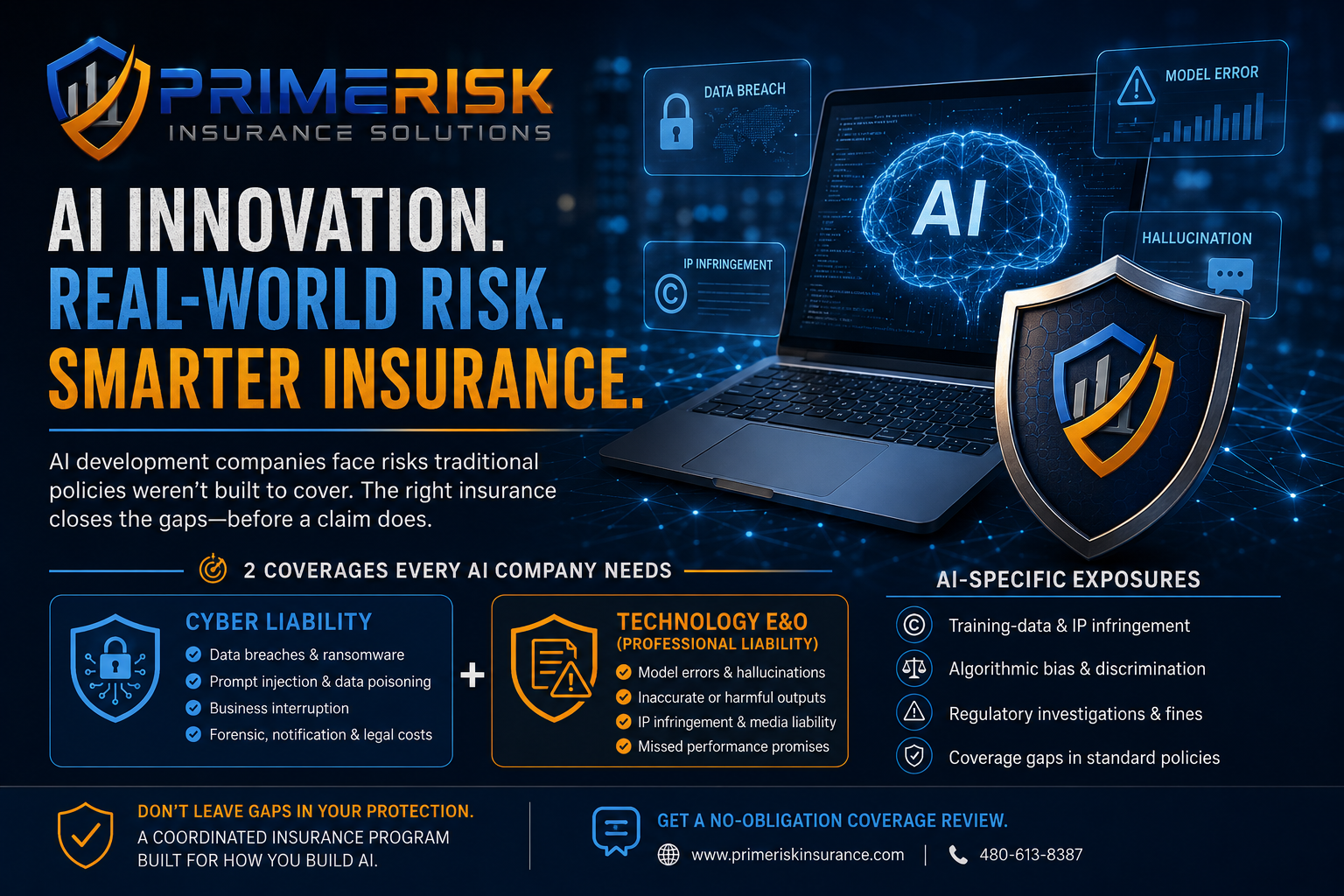
Quick answer: AI development companies need both cyber liability insurance and technology errors & omissions (Tech E&O) coverage, and increasingly a dedicated AI liability endorsement. Cyber responds to breaches, ransomware, and wire fraud; Tech E&O responds to professional failures like a model error, hallucination, or biased output that causes a client a financial loss. Standard policies often carry "silent AI" exclusions, so most AI companies are underinsured without a program built for how they actually operate.
If your company builds, trains, fine-tunes, or deploys artificial intelligence, your risk profile does not fit a standard business policy. You handle large volumes of data, ship software that makes autonomous decisions, and take responsibility for outputs no human reviewed line by line. When a model hallucinates, discriminates, infringes, or leaks data, the claim can land in the gap between policies that were never written for AI. This post explains the two coverages every AI company needs — cyber liability and technology errors & omissions (Tech E&O) — plus the AI-specific exposures that quietly leave developers exposed.
Why AI Companies Are a Different Insurance Risk
Traditional software fails predictably: a bug does the wrong thing the same way every time. AI fails probabilistically. A large language model can produce a confident, wrong, or defamatory answer that no one wrote and no one anticipated. That single shift — from deterministic code to probabilistic output — is why legacy technology policies do not map cleanly onto AI. Add training data of uncertain provenance, third-party model dependencies, and autonomous "agentic" actions, and you have exposures that cyber, Tech E&O, and general liability policies each assume someone else covers.
What Cyber Liability Insurance Covers
Cyber liability covers the financial fallout of a security event. First-party coverage pays your own costs: forensic investigation, data restoration, breach notification, credit monitoring, public relations, and business interruption when systems go down. Third-party coverage pays your liability to others whose data was exposed, including legal defense, settlements, and regulatory fines where insurable. For AI companies, watch for AI-specific twists: data-poisoning attacks that corrupt a training set, prompt-injection incidents that manipulate a model, and the cost of retraining or revalidating a model after its integrity is compromised — none of which a basic cyber form is guaranteed to address.
What Technology E&O Covers
Tech E&O (a form of professional liability) responds when your product or service causes a client a financial loss, with no cyberattack required. For an AI company that means a model that returns inaccurate or harmful outputs, a system that misses its accuracy or uptime commitments, faulty integration work, or bad automated advice a customer relied on. Strong AI-oriented Tech E&O also addresses hallucinations and model errors, and increasingly wraps in media liability for content your system generates — copyright and trademark infringement, defamation, and right-of-publicity claims.
The AI-Specific Coverage Gaps That Catch Developers Off Guard
Silent AI exclusions
Insurers are quietly narrowing AI coverage inside standard cyber, E&O, and D&O forms — through revised base wordings, tighter definitions, and carve-backs rather than one obvious exclusion. Read the endorsements, not just the declarations page, and ask directly whether AI-related claims are covered or excluded.
Training-data and IP infringement
One of the clearest gaps in the market: standard Tech E&O may not cover claims that your model was trained on copyrighted data or that its outputs infringe someone's intellectual property. If you scrape, license, or fine-tune on third-party data, confirm this is affirmatively covered.
Algorithmic bias and discrimination
Claims that a model produced biased or discriminatory outputs fall in a grey zone between cyber and professional liability, and may implicate employment practices or D&O coverage too. Confirm which policy — if any — responds.
Hallucinations and harmful outputs
Inaccurate or damaging AI output can sit awkwardly between cyber, Tech E&O, and general liability. A legacy carrier may deny a hallucination-driven claim outright. Look for affirmative language covering model errors and harmful outputs.
Coverage fragmentation
AI risk spreads across cyber, Tech E&O, D&O, and EPLI, and each insurer narrows its own line independently. The result is "gap risk," where no single policy provides comprehensive protection. A coordinated program — sometimes including a standalone AI liability policy or endorsement — closes the seams.
Regulatory investigation costs
AI-specific regulation is expanding, and defense costs for regulatory inquiries are often excluded or sublimited. Confirm your program addresses investigation and defense expense.
Thin limits and contract requirements
Enterprise customers increasingly demand higher limits, additional-insured status, and proof of AI-specific coverage before they will sign. Many developers carry limits too low to win or keep those contracts.
Key Takeaways
- Cyber and Tech E&O cover different risks; most AI companies need both, plus AI-specific terms.
- "Silent AI" exclusions are being added quietly to standard forms — read the endorsements.
- Training-data and IP infringement is one of the biggest gaps; confirm it is affirmatively covered.
- Hallucinations, model errors, and algorithmic bias sit in grey zones between policies.
- Match your limits and additional-insured requirements to your largest customer contracts.
Frequently Asked Questions
Do AI companies need cyber insurance and Tech E&O, or just one?
Most need both. Cyber covers breaches, ransomware, and wire fraud; Tech E&O covers professional failures such as model errors, missed performance commitments, and harmful outputs. Neither replaces the other, and a single incident can trigger both.
Does insurance cover AI hallucinations and model errors?
Only if the policy says so. Standard technology policies do not explicitly cover probabilistic AI output, and a legacy carrier may deny a hallucination-driven claim. Look for AI-oriented Tech E&O with affirmative model-error and harmful-output language.
Is training-data or IP infringement covered under a standard tech policy?
Frequently not. Claims that a model was trained on copyrighted data or generated infringing content are a known gap. If you train or fine-tune on third-party data, confirm IP and media liability are specifically included.
What is a "silent AI" exclusion?
It is AI risk being removed quietly from a policy through narrowed definitions and carve-backs rather than one clearly labeled exclusion. Because the change is buried in base wording, many policyholders do not realize their AI coverage has shrunk until a claim is denied.
How much does cyber and Tech E&O insurance cost for an AI company?
Premiums vary widely with revenue, data volume, the type of AI you build, your customer contracts, and the limits you need. Because AI programs are highly individualized, a tailored quote is the only accurate answer.
If you build or deploy AI, the fastest way to find your gaps is a side-by-side review of your current cyber and Tech E&O policies against how your models are actually trained, deployed, and contracted. PrimeRisk Insurance Solutions reviews AI technology programs and shoContact us for a no-obligation coverage review.
— PrimeRisk Insurance Solutions | www.primeriskinsurance.com | 480-613-8387