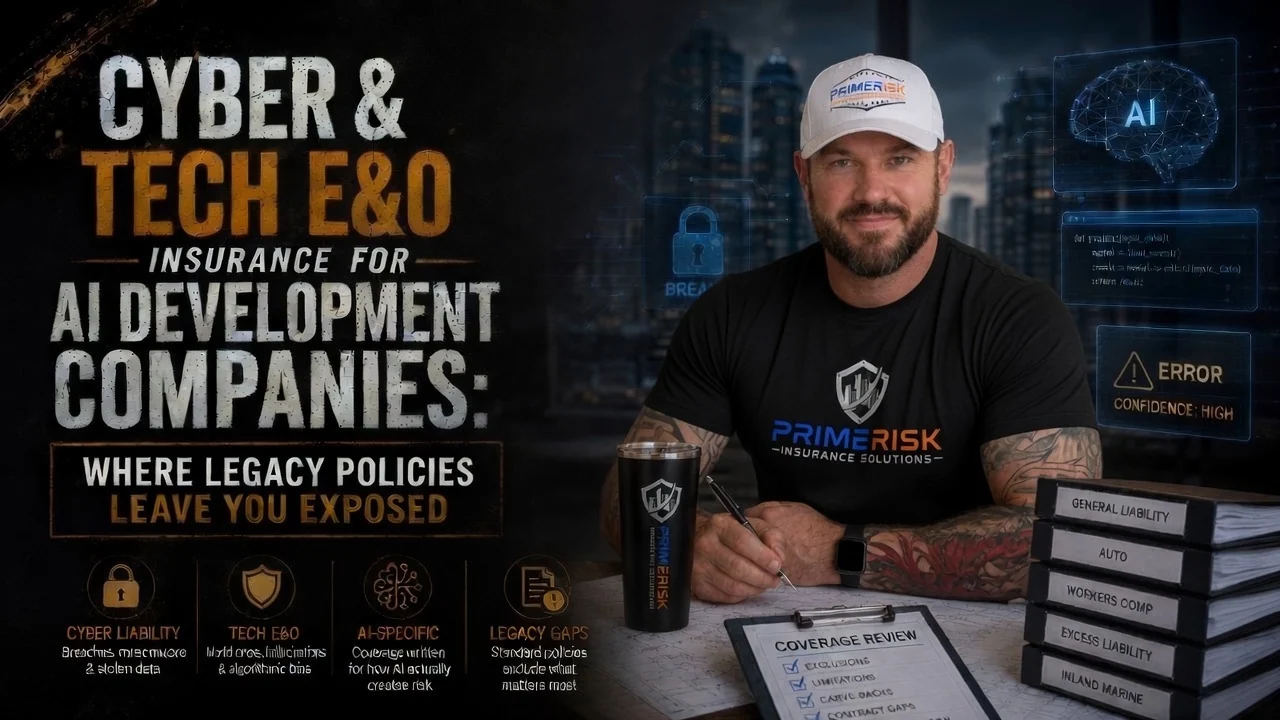
If you build, train, fine-tune, or deploy AI models, your risk profile does not look like a typical software company’s. Your product can be wrong in ways no one intended, can expose the data it was trained on, and can make decisions that harm a third party—all without a single line of code being “broken.” The insurance industry is still catching up to that reality, and many policies AI founders already carry were written for IT consultants, not for companies shipping models. This post explains the two coverages that matter most for AI developers and the gaps that quietly leave them uninsured.
Why AI Companies Carry Risk Traditional Policies Never Anticipated
A conventional technology company’s exposure is fairly predictable: a bug, an outage, a missed deadline, a breach. AI adds a category of loss that older policy language never contemplated. A model can “hallucinate” a confident but false answer that a customer relies on and loses money. It can reproduce copyrighted material it absorbed during training. It can make biased or discriminatory decisions in hiring, lending, or healthcare screening. And the training data itself—often scraped, licensed, or client-supplied—creates intellectual-property and privacy exposure the moment it lands on your servers.
These are sometimes called “grey-zone” liabilities because they fall into the crack between two policies: cyber insurance excludes them because no attack occurred, and legacy Tech E&O excludes them because they were never contemplated in the form. Understanding where that crack sits is the whole game.
What Cyber Liability Insurance Covers for AI Developers
Cyber liability responds to the financial fallout of a security event. First-party coverage pays your own costs after an incident: forensic investigation, data restoration, breach notification, credit monitoring, public relations, and business interruption when systems go down. Third-party coverage pays what you owe others—clients or individuals whose data was exposed—including legal defense, settlements, and insurable regulatory fines.
For an AI company, the highest-value cyber exposures are specific: theft of proprietary model weights, unauthorized access to the training pipeline, a breach of the sensitive data used to train or fine-tune a model, and business email compromise that redirects a wire or an investor payment. A cyber policy is essential—but on its own it will not pay when your model is the source of the loss rather than an attacker.
What Technology E&O Covers—and Why the AI Wording Is Everything
Technology E&O is professional liability for the technology you deliver. It responds when your work product causes a client a financial loss with no cyberattack involved: a model that underperforms its stated spec, a failed integration, a missed launch, or automated output the client relied on to their detriment. It typically also wraps in media liability—covering copyright, trademark, defamation, and right-of-publicity claims arising from content your product generates or publishes.
Here is the trap. Many Tech E&O forms in the market were built for IT consultants and traditional software vendors, and they do not explicitly address losses caused by algorithmic output, model predictions, or automated decision-making. Some 2026 forms even add optional exclusions for losses “arising out of generative artificial intelligence.” If your policy language does not affirmatively cover AI model liability—hallucinations, model error, bias, and training-data disputes—you may be paying for a policy that excludes your core product. The fix is to insist on a form written for AI, not to assume a generic tech policy responds.
The Coverage Gaps That Catch AI Companies Off Guard
Even well-funded AI teams tend to share the same handful of blind spots:
- Assuming a general liability policy or BOP is enough. Both exclude professional errors and most cyber losses. They do not respond to a hallucination, a breach, or an IP claim.
- Believing one policy does both jobs. Cyber will not pay for a model error; Tech E&O will not pay for ransomware. A single AI incident can trigger one, the other, or both—and gaps between them are where uncovered losses live.
- Carrying legacy Tech E&O that never mentions AI. If the form doesn’t name algorithmic output and model liability, assume those losses are contested or excluded.
- Ignoring intellectual-property and training-data exposure. Copyright claims tied to training data and generated output are a fast-growing source of litigation, and many cyber and E&O forms exclude IP infringement.
- Skipping D&O before a raise. Institutional investors almost always require Directors & Officers coverage—and often proof of Tech E&O and cyber—before closing a round.
- Setting limits too low for enterprise contracts. Enterprise customers demand higher limits and additional-insured status. Under-limited programs lose deals or leave the company exposed on a large claim.
Key Takeaways
- AI developers need both cyber liability and a Tech E&O policy written specifically for AI risk.
- Cyber covers attack-driven losses; Tech E&O covers model errors, hallucinations, bias, and training-data disputes.
- Legacy tech policies and 2026 GL forms may exclude the exact AI exposures that define your business.
- Confirm your policy language affirmatively addresses algorithmic output and automated decision-making.
- Add D&O before fundraising, and size limits to your largest enterprise contracts.
Frequently Asked Questions
What insurance does an AI development company need?
At a minimum, cyber liability and a technology E&O policy written to cover AI-specific risks. A complete program usually adds Directors & Officers (especially before fundraising) and commercial general liability. The key is that the E&O form explicitly addresses model errors and algorithmic output.
Does cyber insurance cover AI hallucinations or model errors?
Generally no. Cyber insurance responds to security events like breaches and ransomware. A hallucination or model error that causes a client financial loss—with no attack involved—is a professional liability exposure handled by Tech E&O, not cyber.
Will a standard Tech E&O policy cover my AI product?
Not always. Many Tech E&O forms were written for IT consultants and software vendors and never mention AI. If the language does not affirmatively cover algorithmic output, model predictions, and automated decision-making, those losses may be excluded or disputed. Ask your broker for AI-specific wording.
Are AI companies liable for copyright issues in training data?
They can be. Claims tied to training data and AI-generated output are a growing area of litigation. Because many cyber and E&O forms exclude intellectual-property infringement, AI companies should confirm whether IP and media liability are covered or need to be added.
Do investors require insurance before funding an AI startup?
Frequently, yes. Directors & Officers coverage is commonly required before an institutional round closes, and many investors and enterprise customers also expect proof of Tech E&O and cyber liability coverage as a condition of doing business.
Talk to PrimeRisk
AI coverage is where the fine print decides everything. A policy that looks complete on a certificate can exclude hallucinations, bias, or training-data claims in the actual form—the exact risks that define an AI business. PrimeRisk Insurance Solutions reviews your cyber and Tech E&O program line by line, flags the AI exclusions that matter, and structures coverage that responds when your model is the source of the loss. Contact us for a no-obligation coverage review.