
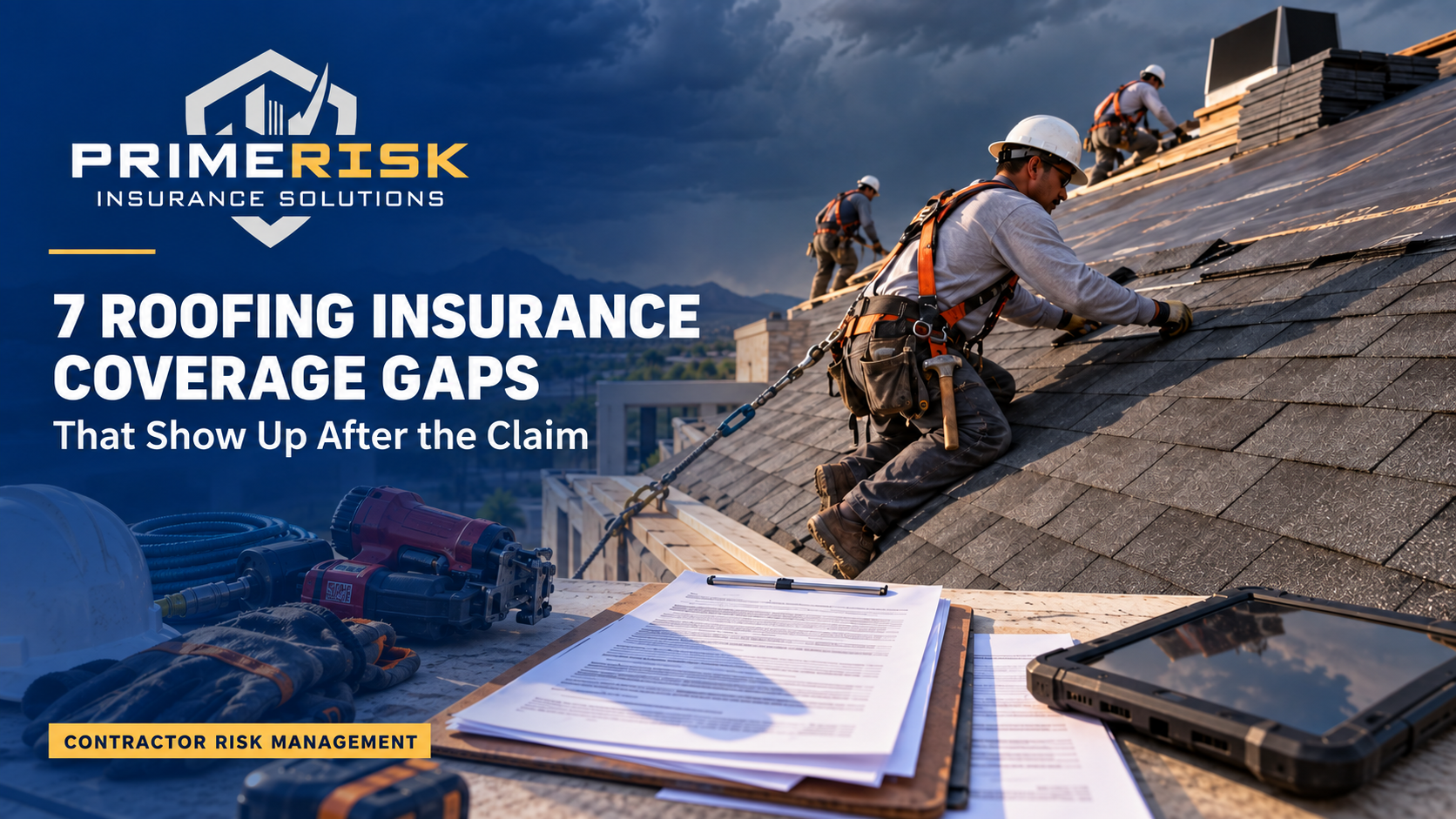
Roofing Contractor Insurance: The Coverage Gaps That Get Claims Denied

Kody Houk
Quick answer:
Roofing contractors need general liability, workers' compensation, commercial auto, and umbrella/excess coverage at a minimum. But the biggest risks hide in policy exclusions—height limits, subcontractor gaps, and hot-work exclusions—that can void a claim after a loss. A coverage review catches these gaps before a claim does.
Why roofing is one of the hardest trades to insure
Roofing combines almost every risk factor an underwriter worries about: working at height, open flame on torch-down and modified-bitumen systems, heavy equipment, weather exposure, and frequent use of subcontractors. Because of that, roofing carries one of the highest workers' compensation rates of any trade, and general liability premiums for roofers run well above those of most other contractors.
The result is that many roofing contractors end up buying coverage on price alone—and inherit a policy stitched together with exclusions they never read. The coverage looks complete on the certificate. It isn't. The gaps only surface when a claim is filed and denied.
The core coverages every roofing contractor needs
A well-built roofing insurance program usually starts with these lines:
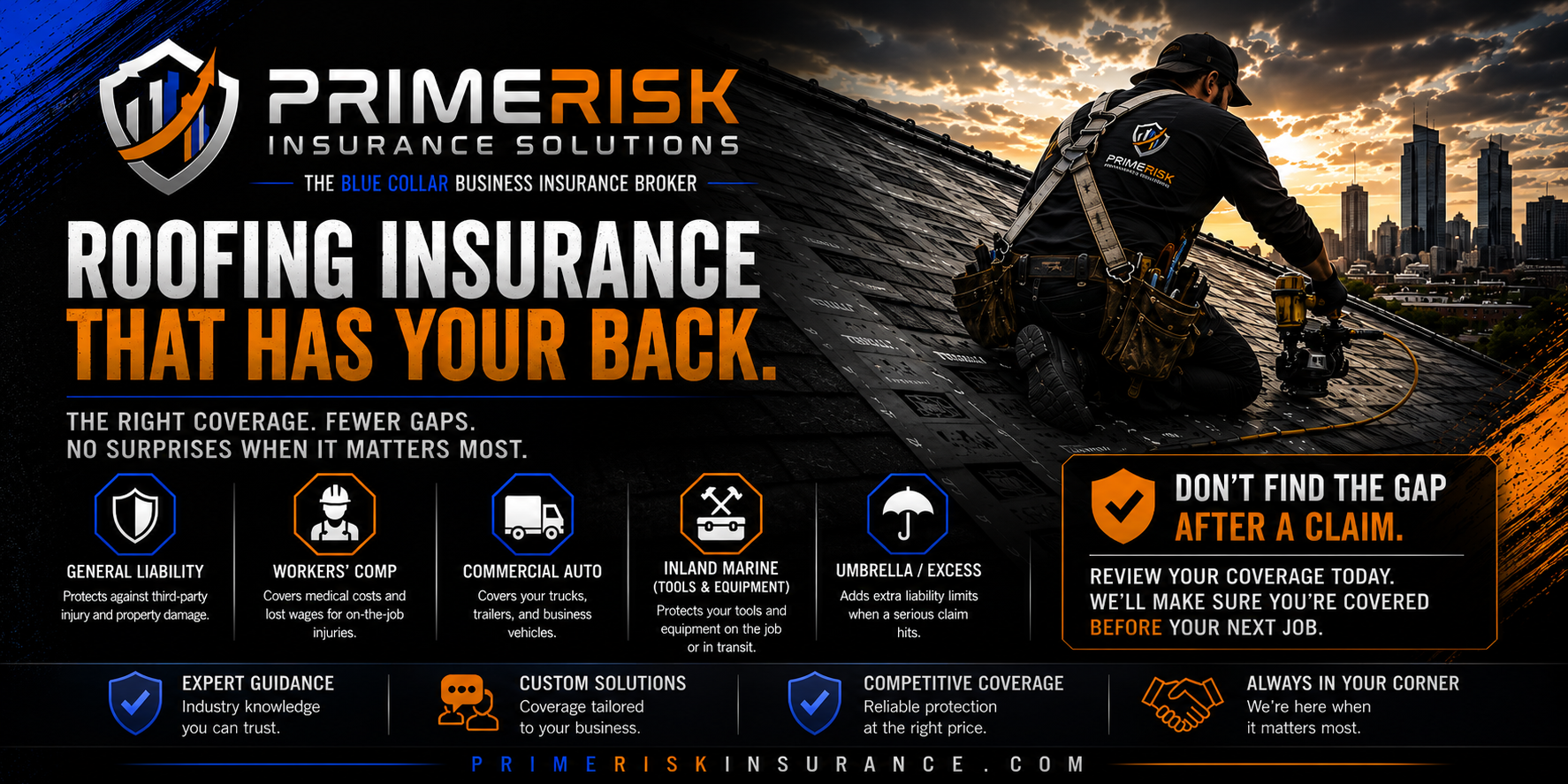
- General liability (GL): Covers third-party bodily injury and property damage—a dropped bundle of shingles, water intrusion from an open roof, damage to a homeowner's landscaping. Most contracts and GCs require a $1 million per-occurrence and $2 million aggregate limit.
- Workers' compensation: Required in nearly every state once you have employees. It pays medical bills and lost wages for on-the-job injuries—and because falls are the leading cause of roofing injuries, this is both your most expensive and most essential coverage.
- Commercial auto: Covers your trucks and trailers hauling crews, materials, and dump loads. Personal auto policies exclude business use, so company vehicles need commercial coverage.
- Inland marine (tools & equipment): Covers compressors, nail guns, ladders, and other gear on the job, in transit, or stored—property that a building policy typically won't cover once it leaves your shop.
- Umbrella / excess liability: Sits on top of GL and auto to provide additional limits. Many commercial contracts now require it, and a single serious fall or vehicle claim can exhaust a primary limit quickly.
- Contractors professional / E&O (when applicable): Worth considering if you design roof systems or advise on specifications rather than simply installing to someone else's plans.
The exclusions that quietly void roofing claims
Here's where most roofing programs fail. The core coverage is fine—the damage is done by exclusions and missing endorsements. Watch for these:
Height limitations
Some GL policies exclude work performed above a set height—commonly 15, 25, or 35 feet, or above three stories. Since roofing routinely exceeds those thresholds, a height exclusion can wipe out coverage for exactly the work you do most.
Subcontractor exclusions
If you use subs, an exclusion for subcontracted work can remove coverage for the majority of a project. Confirm the exclusion is removed where appropriate, collect certificates of insurance from every sub, and require written subcontractor agreements.
Hot-work and torch-down exclusions
Built-up, modified-bitumen, and torch-applied systems involve open flame. Many standard policies exclude these operations entirely. If you do any torch work, your policy needs to reflect it—or a fire loss won't be covered.
Roofing operations and completed-operations gaps
Some policies limit or exclude specific roofing operations, or drop completed-operations coverage—the coverage that responds when a leak or defect shows up months after you've left the job. Without it, warranty-period claims fall back on you.
Common coverage gaps to review before your next job
Beyond outright exclusions, these are the gaps we see most often on roofing accounts: workers' comp misclassification or employees run as "1099" who aren't truly independent; certificate requirements from a GC that your policy can't actually satisfy; equipment left off the schedule; and umbrella limits that haven't kept pace with the size of jobs you now bid. Each one is fixable—but only if it's found before a loss.
Key takeaways
- Roofing is among the highest-rated trades for both workers' comp and general liability—price-shopping alone usually buys hidden exclusions.
- The essential lines are GL, workers' comp, commercial auto, inland marine, and umbrella/excess.
- Height, subcontractor, and hot-work/torch-down exclusions are the most common ways a roofing claim gets denied.
- Completed-operations coverage protects you when a leak surfaces months after the job.
- Collect COIs from every subcontractor and confirm your certificates meet each contract's requirements.
Frequently asked questions
What insurance does a roofing company need?
At a minimum, a roofing company should carry general liability, workers' compensation, and commercial auto. Most also need inland marine coverage for tools and equipment and an umbrella policy for additional limits. The exact program depends on your operations, payroll, and the contracts you sign.
How much does roofing contractor insurance cost?
It varies widely by state, payroll, revenue, claims history, and the type of roofing you do. General liability commonly runs a few hundred dollars a month for smaller operations, while workers' compensation is typically the largest cost because roofing is rated as one of the highest-risk trades. A tailored quote is the only way to get an accurate number.
Does general liability cover falls from a roof?
No. Injuries to your own employees are covered by workers' compensation, not general liability. General liability responds to third-party injury and property damage—such as a passerby or the client's property—not to your crew's workplace injuries.
Why would a roofing insurance claim be denied?
The most common reasons are policy exclusions that match the work being done—height limitations, subcontractor exclusions, or hot-work/torch-down exclusions—along with worker misclassification and lapses in required coverage. Reviewing your policy language before a loss is the best way to avoid a surprise denial.
Do I need insurance for subcontractors I hire?
Yes. Require each subcontractor to carry their own general liability and workers' compensation, collect a certificate of insurance before work starts, and use written agreements. Uninsured subs can fall back on your policy—and trigger higher audit charges—if you don't.
Get a roofing coverage review
If you're not sure whether your policy has a height limit, a subcontractor exclusion, or a torch-down gap, that uncertainty is the risk. PrimeRisk Insurance Solutions works with roofing contractors to build programs that match how you actually operate—and to close the gaps that lead to denied claims. Contact PrimeRisk today for a no-obligation coverage review and know exactly what you're covered for before your next job.