
Yes. In most cases you can change insurance agents without changing your carrier, your coverage, your limits, your deductible, your premium, or your renewal date. It is called a broker of record change, and it takes one signed form. The only thing that moves is who services your account and who earns the commission that is already built into your rate.
If you are an HVAC, plumbing, or electrical contractor in Arizona and your complaint is slow certificates of insurance, unreturned calls, or endorsements that take three weeks, you do not have a policy problem. You have an agent problem. Those are two very different things, and the fix for one is not the fix for the other.
The mistake most contractors make when service goes bad
Here is how it usually goes. Your certificates take forever. You are on a job site waiting on a COI so you can start work. You call your agent, you get voicemail, and by the time somebody calls you back the GC has moved on.
So you decide you are done. You call three agencies. And every one of them tells you the same thing: fill out this form, we will shop it, we will get you quotes from ten carriers.
That is the wrong answer, and it is usually the wrong answer for one simple reason. Those agents do not know yet whether your current carrier is good. They have not looked. They cannot look, because you have not given them anything to look at. So they default to the only play they know, which is a full market submission.
I had this exact call recently with an HVAC contractor here in the Valley. She was insured with one of the national "contractor specialty" agencies. Terrible service. Weeks to get an endorsement processed. But she was placed with the single best carrier we use for HVAC, plumbing, and electrical work. Great forms. Cheap, useful endorsements. Underwriters who hand out credits at renewal when the business shows real improvement.
Shopping that account would have been a disservice to her. Somebody out there could have come back with a cheaper number. It would not have been because they found a better market. It would have been because they cut coverage to get there and did not tell her.
What is a broker of record letter?
A broker of record letter, sometimes called an agent of record or AOR letter, is a short signed document that tells your insurance company which agency represents you from this point forward. The industry standard form is ACORD 36, Agent/Broker of Record Change.
What it does:
- Transfers servicing and representation of your policy to the new agency
- Gives the new agency access to your policy, your loss runs, and your carrier contacts
- Redirects the commission already baked into your premium to the new agency
What it does not do:
- Cancel your policy
- Change your carrier
- Change your limits, deductibles, endorsements, or exclusions
- Change your premium
- Change your renewal date
Coverage changes still require actual endorsements. A BOR letter by itself changes nothing about your protection.
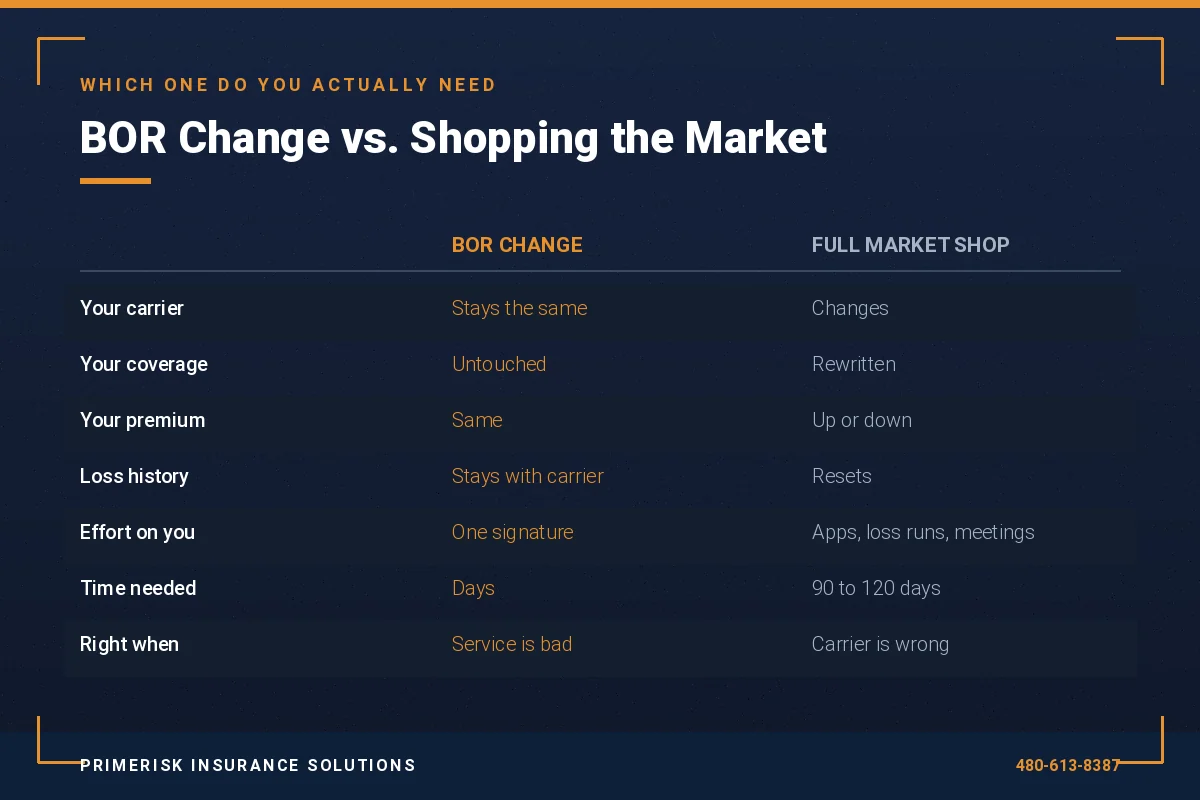
Broker of record change vs. shopping the market
| Broker of record change | Full market shop | |
|---|---|---|
| Your carrier | Stays the same | Changes |
| Your coverage | Untouched | Rewritten, and forms differ carrier to carrier |
| Your premium | Same | Could go up or down |
| Loss history | Stays with a carrier that already knows you | Reset with a new underwriter |
| Effort from you | One signature | Applications, loss runs, comparisons, meetings |
| Right move when | The coverage is good, the service is bad | The carrier is wrong for your class, or your rate is genuinely off market |
Both are legitimate. They just solve different problems.
Why your new agent might tell you to wait for renewal
This is the part nobody in my business explains honestly, so here it is.
Many carriers will only process a broker of record change at renewal. Some will take one midterm, meaning in the middle of your policy year. When a carrier does allow a midterm BOR, the incoming agency usually inherits real financial exposure. The prior agent has already been paid the commission on that policy. If the policy cancels before it expires, the new agency can be on the hook to pay that commission back.
So if you call an agency midterm and they suggest waiting until your renewal, that is not laziness. That is an agency being careful with a business relationship that is one week old. An agency willing to take that risk for you is telling you something. So is one that will not.
There is also a waiting period. Once the BOR letter hits the carrier, most insurers hold it for a short window, commonly around five to ten days, and notify the outgoing agency. That agent gets a chance to keep the account. Expect a phone call. Expect it to be a good one.
The timing problem: do not wait until 10 days out
The HVAC contractor I mentioned was ten days from her renewal date when we talked.
Ten days is enough time to sign a BOR and transfer servicing. It is not enough time to properly market an account. Negotiating rate with an underwriter takes weeks. You need current loss runs, updated payroll and receipts, an accurate schedule of vehicles and equipment, and a real conversation about what changed in your business this year. Underwriters do not give their best terms to a submission that landed on Tuesday for a Friday effective date.
If you know your service is bad, start the conversation 90 to 120 days before your renewal. That gives a new broker room to do either job properly, whichever one your account actually needs.
How to interview an insurance agent (the questions that matter)
Stop asking agents for quotes. Start asking them how they run an account.
- What is your turnaround time on a certificate of insurance? Same day is the standard. If they hedge, that is your answer.
- Who do I call? A named person, a direct line, and a backup. Not a general inbox.
- What is your turnaround on an endorsement? Adding a vehicle, adding an employee, adding an additional insured on a new contract.
- How many carriers do you write my trade with, and which one do you use most? A broker who cannot answer this instantly does not specialize in you.
- What do you do between renewals? If the honest answer is nothing, you will be back here in a year.
- Will you tell me when I should stay put? The one I care about most. An agent who has never talked a prospect out of moving is selling, not advising.
Then hire the one you trust. That is broker selection, and for a scaling contractor it matters more than the number on page one of a proposal.
When you actually should shop the market
I am not saying never shop. There are real cases where moving carriers is the right call:
- You are in a high risk class like roofing, restoration, or demolition, where carrier appetite swings hard and the spread between markets is wide
- Your current carrier does not want your class of business and is rating you accordingly
- You have coverage gaps your current policy cannot fix by endorsement
- Your losses have improved significantly and your current carrier has not moved
- You are growing into a size or complexity your carrier does not handle well
We move accounts for those reasons regularly. We just do not move them because somebody wanted a commission.
The bottom line for Arizona contractors
If your coverage is right and your service is garbage, you do not need ten quotes. You need a different agent.
Shop the broker, not the market. Let the broker shop the market for you, and only when there is a real reason to.
Frequently asked questions
Does a broker of record letter cancel my insurance policy? No. A BOR letter changes which agency represents you and services your account. Your policy, carrier, limits, deductibles, endorsements, premium, and expiration date all stay as they are unless you separately request a change.
Can I do a broker of record change in the middle of my policy term? Sometimes. It depends on the carrier's rules. Many insurers only process a BOR change at renewal, and others allow midterm changes but may require the incoming agency to accept commission chargeback risk if the policy cancels early. Ask both agencies before you sign anything.
Will my premium go up if I switch insurance agents? It should not. The commission is already built into your rate and is paid to whichever agency represents you. Changing agents does not by itself add cost to the policy.
How long does a broker of record change take? Most carriers hold the letter for a short waiting period, often around five to ten days, and notify your current agent before the change takes effect. Full transfer of servicing generally happens within about 30 days.
Do I have to tell my current agent I am leaving? You do not have to make the call yourself. The carrier notifies the outgoing agency during the waiting period, and that agent will usually reach out to try to keep the account.
Should HVAC, plumbing, and electrical contractors shop their insurance every year? Not automatically. These trades tend to sit with carriers that write them well and price them fairly. An annual market sweep for the sake of it can cost you underwriter goodwill and renewal credits. Review your coverage every year. Market the account when there is a reason to.
Talk it through before your renewal. If you are an HVAC, plumbing, or electrical contractor in Queen Creek, Gilbert, Mesa, Chandler, or anywhere in the Phoenix East Valley and you are not sure whether you have an agent problem or a carrier problem, that is a fifteen minute conversation. Call Kody Houk at PrimeRisk Insurance Solutions at 480-613-8387 or email kody@primeriskinsurance.com.
Start it 90 days out. Not ten.