
Arizona roofing contractor insurance: Roofing is hard to insure.
We know where the gaps hide.
Leaks that show up years later. Subs on the roof. Contracts that demand more than your policy gives. Your coverage should start with the work you actually do, not a generic contractor form.
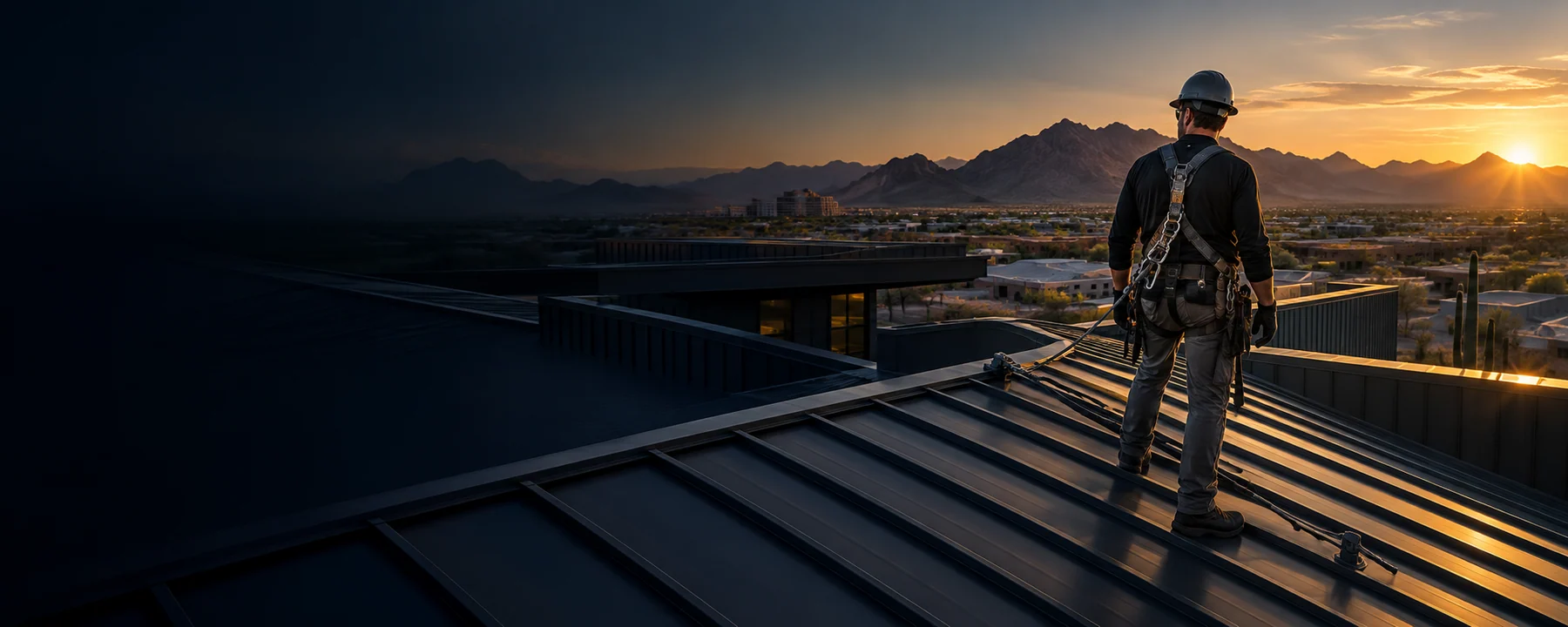
BUILT FOR THE WORK ABOVE IT ALL

Your roof systems, your crews and your contracts, checked against what your policy really says.
Get my quote Book a callWhat we look at first.
We start with your operations and the questions that matter to your business.
- Residential or commercial work, including the roof systems you install or repair.
- Employee roles, payroll, subcontractor use and job-site responsibilities.
- Contract insurance requirements, additional insured requests and completed operations.
- Vehicles, tools, equipment and the locations where you work.
What to have ready.
A few details help make your first conversation more useful.
- Your current policies and renewal dates.
- A breakdown of your roofing operations and annual revenue.
- Employee payroll, subcontractor costs and available loss runs.
Questions roofers ask us.
Why does the type of roofing work matter?
An insurer’s appetite and policy terms may differ by operations. Describe your actual work accurately and ask an agent to review exclusions, limitations and endorsements against it.
Does a certificate prove that everything is covered?
A certificate summarizes insurance information. Coverage depends on the actual policy and applicable endorsements, so contract requests should be reviewed alongside the policy documents.
Coverage depends on your operations, location and policy terms. We’ll walk through yours with you.
THE SHORT ANSWER
What insurance does an Arizona roofing contractor need?
Most Arizona roofers need general liability that includes completed operations, workers’ comp for employees, commercial auto for trucks and trailers, coverage for tools and equipment, and the ROC license bond. Many also carry an umbrella because contracts ask for higher limits. The catch is that roofing liability is often written with limits or exclusions on height, hot work, residential projects or certain roof types, so the policy has to match the work your crews actually do.
Usually covered
- Injury or property damage to others caused by your work, subject to the policy terms.
- Damage that shows up after the job is finished, such as a leak that damages a customer’s ceiling (completed operations).
- Injuries to your employees (workers’ comp).
- Your trucks and trailers on the road (commercial auto).
- Tools and equipment listed on an inland marine or equipment policy.
Usually not covered
- The cost to tear off and redo your own faulty work.
- Work the policy excludes, such as jobs over a height limit, torch-down or other hot work, or certain residential projects.
- Injuries to a subcontractor’s crew when the sub had no comp. That cost can land on your audit.
- A workmanship warranty you promised the customer.
- Tools stolen from a truck if the policy’s theft conditions were not met.
Three gaps we see most
- Height, hot-work and roof-type exclusions
A policy can look complete on the declarations page and still exclude torch-down, work above a set number of stories, or the roof systems you install most. Read the endorsements against your last ten jobs, not against a generic “roofing” label.
- Residential and multi-family exclusions
Some roofing policies exclude or limit tract homes, condos, townhomes or new residential construction. If you take subdivision or multi-family work, confirm it is covered before you bid it.
- Subcontractor paperwork
If a sub has no current certificate or comp coverage, the premium audit can charge their labor as your payroll, and a claim on their work can fall to your policy. Collect certificates and endorsements before the sub starts, and keep them current.
The Arizona angle
- Workers’ comp. Arizona’s workers’ compensation law applies to employers who regularly employ workers (A.R.S. § 23-902), so a roofing crew on payroll generally needs coverage.
- ROC license bond. Residential specialty contractors need a $4,250 bond under $375,000 in annual volume and $7,500 at or above it. Commercial specialty bonds run from $2,500 to $50,000 based on volume. Use our AZ ROC bond tool to find yours.
- Heat and monsoon. Summer heat raises heat-illness risk on crews, and monsoon storms bring open-roof water damage claims and a rush of storm work. Ask how your policy treats roofs left open and what your crews must do to protect them.
More questions
Does general liability pay to fix a roof I installed wrong?
Usually not. General liability is built for damage to other property and injuries to others. The cost to correct your own faulty work is generally excluded, while resulting damage to the building or its contents may be covered, depending on the policy wording.
Do I need workers’ comp if I only use subcontractors?
You may still need it. Insurers and auditors look at whether your subs carry their own coverage. Without certificates and proof of their comp, their labor can be counted as your payroll at audit time.
Can I add hot work or a new roof type later?
Often, but tell us before you start the work. Adding an operation mid-term can change the price or need a different insurer, and finding out after a claim is the expensive way to learn it was excluded.
Go deeper: Roofing Leak Claims: What Completed Operations Covers · Roofing GL: Subcontractor Gaps That Trigger Claims · Arizona Roofing GL Exclusions That Cost Claims · Arizona Roofers: Heat Illness and Workers Comp Claims
General information, not a coverage decision. Coverage depends on the policy wording, endorsements and the facts of a claim. Statutes summarized as of October 1, 2026.
COVERAGE QUESTIONS, ANSWERED
Arizona Roofing Contractor Insurance
Roofing contractor insurance needs to reflect the roof systems, buildings, and methods your crew actually works with. A general liability policy is one part of the discussion; employee injuries, vehicles, equipment, subcontractors, and contractual limits need separate attention.
| Operations and exclusions | Describe repairs, replacement, new construction, roof types, height, and any heat-related work. Ask which operations are excluded or restricted. |
|---|---|
| Employees and subcontractors | Review payroll classifications, subcontractor documentation, and how changes in your crew affect the application and audits. |
| Completed work | Discuss allegations of damage after the job is finished, completed operations, and the difference between repairing your work and damage to other property. |
What affects the cost?
Revenue, payroll, roof types, project mix, subcontractor use, claims experience, and coverage limits help shape a roofing quote. A low premium is less useful if the policy excludes a major part of your work. Provide the same operations breakdown to each insurer for a meaningful comparison.
What should I bring to a roofing insurance review?
Bring policies and endorsements, available loss runs, payroll and revenue estimates, subcontractor costs, roof-system details, and customer contract requirements. List any work you plan to add so it can be discussed before you begin.
ILLUSTRATIVE SCENARIO
Where policy details matter.
A completed roof is alleged to have leaked and damaged the inside of a building. The cost to correct the roof and the resulting interior damage can raise different coverage questions. Policy wording, the cause of the loss, and the work performed all matter.
Educational reference: Arizona Industrial Commission: workers’ compensation requirements. Examples do not establish coverage for a particular claim.
Get my quoteROOFING RISK ROADMAP
Four steps. No guesswork.
Understand
Describe your roof systems, job types, crew, and subcontractors.
Review
Review the work described by your policies and relevant exclusions.
Compare
Compare coverage options with your contracts and business needs.
Revisit
Revisit your program as your operations and projects change.
Our Roadmap is a review approach, not an insurance policy or a guarantee that every risk is covered. Coverage depends on the policies and endorsements selected.